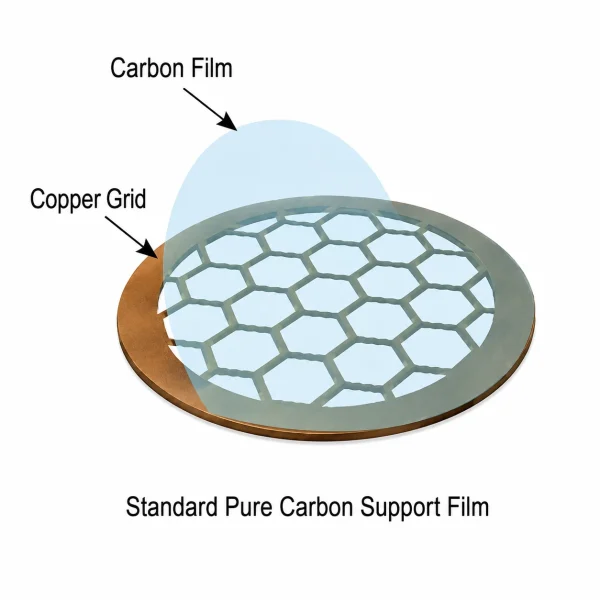



200–400 Mesh Copper TEM Grids with Pure Carbon Support Film
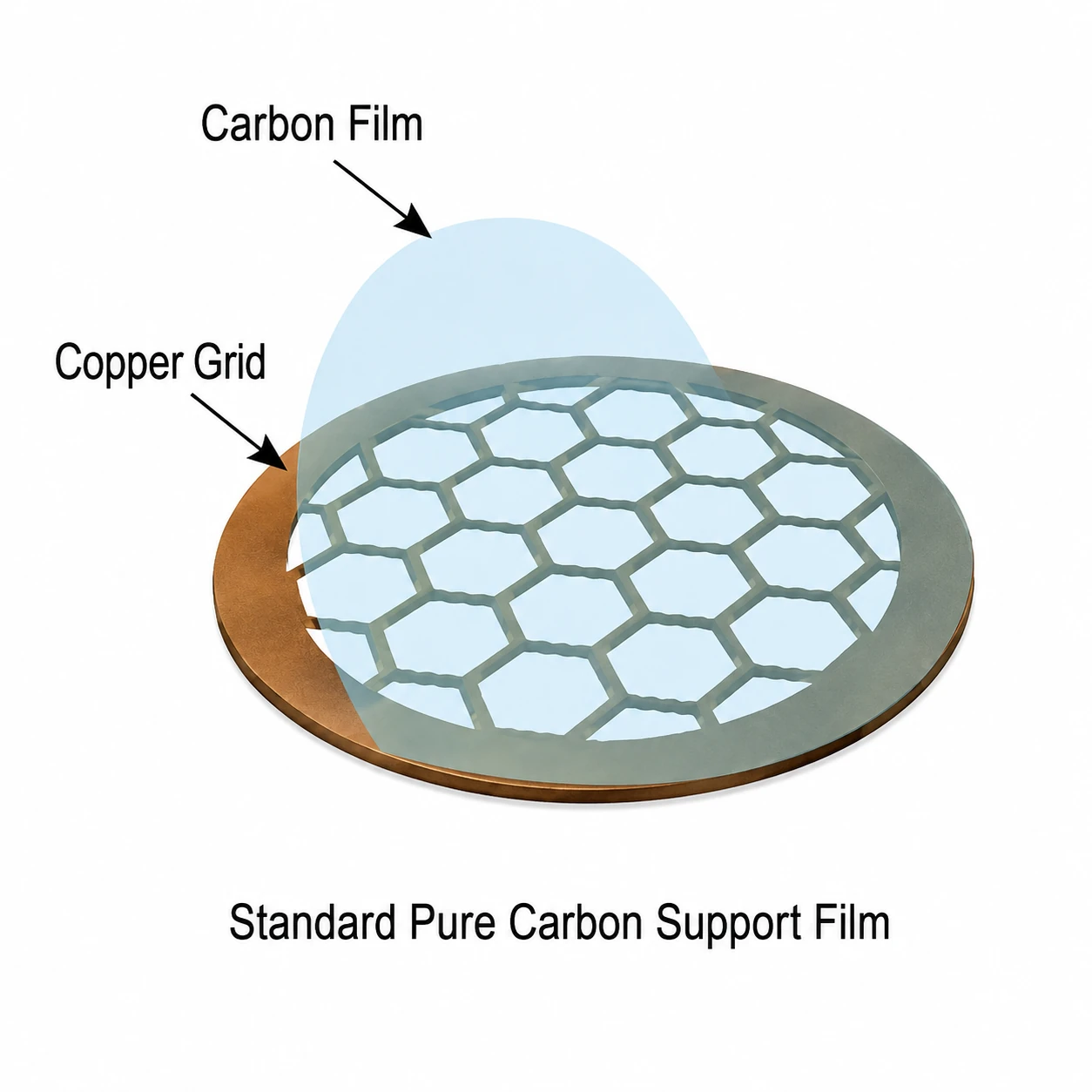
Pure Carbon Support Film
Standard pure carbon support film is suitable for nanomaterial samples
dispersed in organic solvents such as chloroform and toluene.
Unlike conventional carbon support films, pure carbon support film
contains no Formvar layer and consists only of the TEM grid and
carbon layer. The higher carbon density provides improved film
stability and reduces the likelihood of film breakage.
The carbon film provides good electrical and thermal conductivity,
helping reduce specimen drift and improve sample stability during
TEM observation. It is suitable for general morphology imaging.
Because there is no organic Formvar layer, the background is cleaner,
which can provide better imaging results for high-resolution TEM.
It is particularly suitable for specimens that require processing
or dispersion in organic solvents.
Pure carbon support film is more fragile than support films containing
an organic backing layer, so more careful handling is recommended
during specimen preparation.
Product Specifications
| Mesh | 200–400 Mesh |
| Grid Material | Copper |
| Support Structure | Copper Grid + Pure Carbon Film |
| Total Film Thickness | 10–15 nm |
Carbon Support Film Terminology
Copper grids are economical and widely used. Therefore, terms such as
“copper grid support film,” “carbon support film,” “carbon film,”
and “Formvar film,” and sometimes even the simplified term
“copper grid,” are often used to refer to a copper TEM grid
carrying a carbon-coated support film. The general term is
carbon support film.
Microgrid Support Film
A microgrid is a type of support film in which micropores are
intentionally formed during fabrication. It is therefore also
referred to as a microgrid support film.
The microgrid is also carbon coated and generally has a film
thickness of 15–30 nm. Its main purpose is to allow specimens
to be supported near the edges of the micropores so that portions
of the sample can be observed without an underlying film.
Film-free observation helps improve image contrast. Microgrid
support films are commonly used for tubular, rod-shaped and
nanoparticle aggregate specimens and are particularly suitable
for high-resolution imaging.
During specimen preparation, carbon support films and small-hole
microgrids are commonly used. For high-resolution imaging, specimen
thickness is preferably controlled below 20 nm. Powder particles
smaller than approximately 20 nm can generally be picked up directly,
while larger particles are usually embedded and then ion milled.
Ultrathin Carbon Support Film
Ultrathin carbon film is another type of support film. It consists
of a microgrid support film with an additional very thin carbon
layer deposited over the holes, generally about 3–5 nm thick.
The ultrathin carbon layer covers the micropores and is mainly
intended for nanomaterials with good dispersion, especially
well-dispersed specimens smaller than 10 nm.
Porous Carbon Support Film
Porous carbon support film combines characteristics of conventional
carbon support films and microgrid support films.
Conventional carbon support films are mainly used for morphology
observation and evaluation of specimen dispersion, while microgrid
support films are mainly used for high-resolution imaging.
Because porous carbon film provides a relatively large supporting
area while also containing micropores, it can be used for dispersion
evaluation, morphology observation and high-resolution imaging,
making it a practical general-purpose support film.



Reviews
There are no reviews yet.