


300–400 Mesh Copper TEM Grids with Carbon Support Film

Ultrathin Carbon Film
Ultrathin carbon film is a type of support film in which an additional
very thin carbon layer is deposited over a microgrid support film.
The typical thickness of this ultrathin carbon layer is 3–5 nm.
The purpose of the ultrathin carbon layer is to cover the micropores.
It is mainly intended for well-dispersed nanomaterials, especially
samples smaller than 10 nm.
When a microgrid is used alone, very small particles may pass through
the micropores. Particles located near the edge of a micropore may also
be more difficult to observe because of the greater film thickness
around the hole.
Ultrathin carbon film therefore provides better observation results
for these specimens. Available grid materials include copper, nickel,
molybdenum and gold.
Microgrid Carbon Support Film
Microgrid carbon film is a type of support film with micropores
formed in the film during preparation. It is therefore also referred
to as a microgrid support film.
The support film is carbon coated and typically has a film thickness
of 15–20 nm. Its main purpose is to allow specimens to be positioned
near the edges of the micropores for observation without an underlying
support film, helping improve image contrast.
Microgrid support films are commonly used for observing tubular,
rod-shaped and nanoparticle specimens. They are particularly useful
for high-resolution imaging of these materials.
Carbon film thickness can be customized according to the application.
For specimen particles smaller than 10 nm, ultrathin carbon film
is recommended.
Carbon Support Film
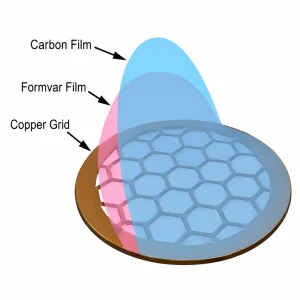
Carbon support film is a specimen carrier used for transmission
electron microscopy (TEM). A carbon layer is deposited over
an organic Formvar film.
During TEM observation, the grid support film may accumulate charge
under electron-beam irradiation, causing specimen charging, drift,
movement or support-film cracking.
Carbon coating improves the electrical conductivity of the support
film and helps provide better observation results.
This carbon-coated grid support film is referred to as a carbon
support film and typically has a film thickness of 7–10 nm.
The support film is mainly composed of an organic layer with a thin
carbon coating, so background influence is generally low.
Samples are commonly dispersed in water or ethanol, and the support
film is generally resistant to corrosion.
Double-Grid Carbon Support Film
Double-grid carbon support film is designed specifically for magnetic
specimens. Magnetic samples may contaminate the electron microscope,
so carbon films are mounted on both grids and the specimen is enclosed
between them for protection.
The double-grid carbon support film is simple to use and is handled
similarly to a conventional single-grid carbon support film.
The dispersed specimen is placed on one grid and the second grid
is then attached over it.
This reduces the complicated conventional preparation procedure
for magnetic specimens and significantly shortens specimen preparation
time. Magnetic powder specimens can be prepared either by resin
embedding with ultrathin sectioning or by using a double-grid
carbon support film.
Quantifoil Holey Carbon Film
Quantifoil is a perforated support film with precisely arranged
holes of different sizes and shapes. Compared with conventional
holey carbon films, it offers advantages for transmission electron
microscopy (TEM) grids and low-energy electron point-source
microscopy (LEEPS).
The fixed geometric arrangement of Quantifoil holes facilitates
automated operation in TEM, which is generally not possible with
conventional carbon films.
Quantifoil carbon support films have a large open-hole area and are
commonly used to reduce specimen thickness and minimize artifacts
caused by the support film.
The perforated carbon film can support ultrathin films or can be used
directly as a carrier for larger specimens such as micron-scale
powders. This is important for electron diffraction (ED),
electron energy-loss spectroscopy (EELS), EELS imaging and
dark-field imaging.
The film can also be used for nanomaterial characterization,
including studies of biological macromolecular complexes freely
suspended over the holes.
Surface properties of Quantifoil grids, especially wettability,
can be adjusted according to user requirements. Like other carbon
films, untreated Quantifoil films gradually lose hydrophilicity
over time, while newly prepared carbon films generally have
better hydrophilicity.
Round-Hole Quantifoil Carbon Film
Round-hole Quantifoil carbon film is more suitable for cryogenic
transmission electron microscopy (Cryo-TEM), because circular holes
help form ice layers with more uniform thickness.
Hole spacing should be selected according to the required magnification
and whether the support-film pattern will appear in the final image.
If the film is included in the final image, image-quality evaluation
is easier because the film provides more acceptable isolated ice areas.



Reviews
There are no reviews yet.