





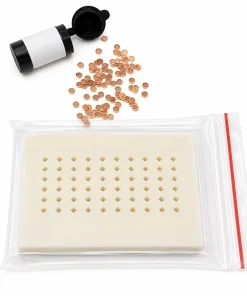
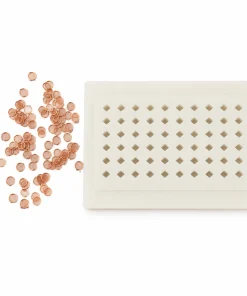
PT1 PELCO Copper TEM Grids with Carbon & Microgrid Support Films
$200.00
PELCO Copper TEM Grids with Carbon Microgrid Support Films
Frequently Asked Questions
1. What is the difference between copper grids, carbon support films, microgrid films, and ultrathin carbon films?
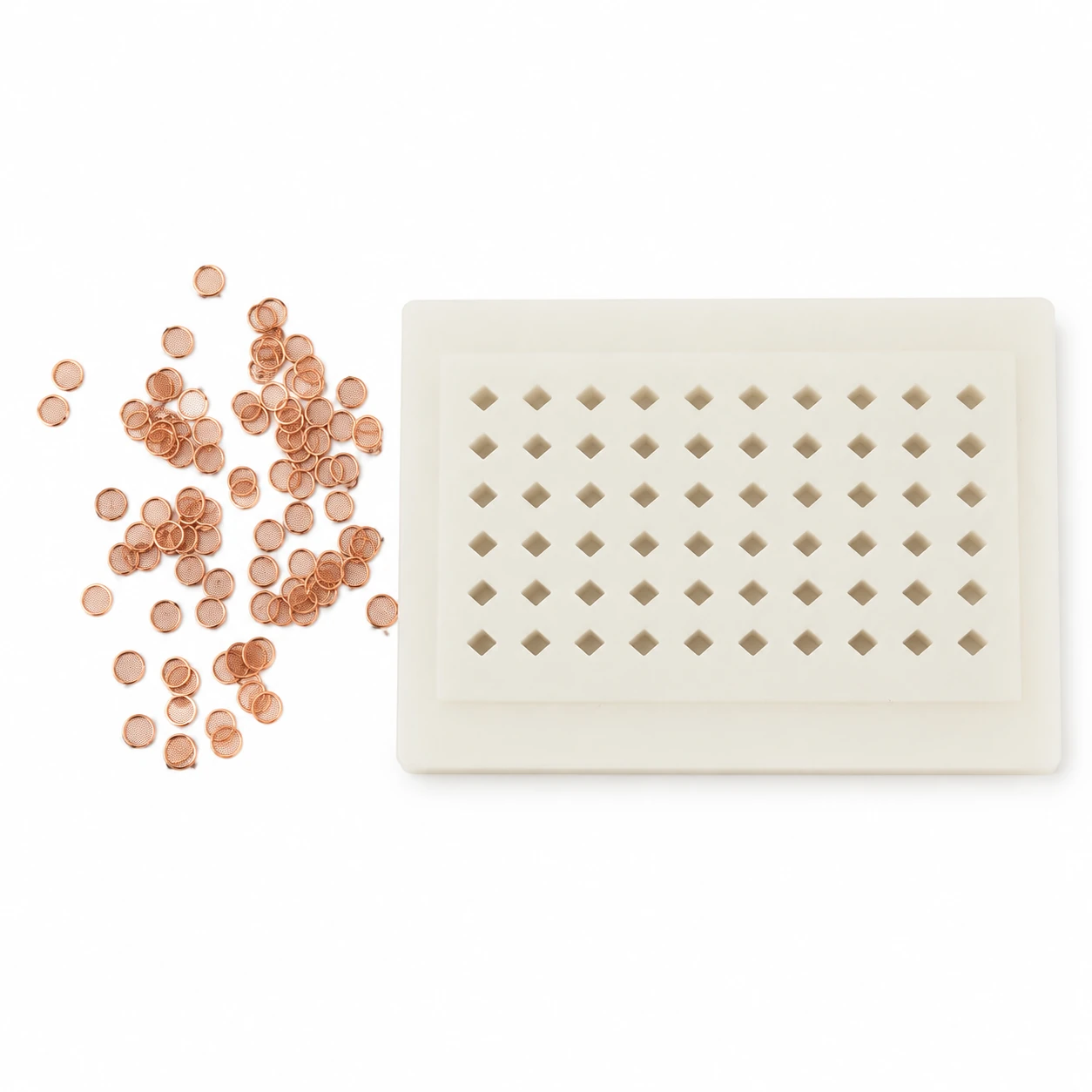
Copper grids are the standard specimen grids used in transmission electron microscopy (TEM) to carry samples.
If the grid material is copper, it is called a copper grid. If the material is nickel, molybdenum, gold, or nylon,
it is correspondingly called a nickel grid, molybdenum grid, gold grid, or nylon grid. Copper grids are also known as
bare grids. They are mainly used in biological sample preparation and can be used with an ultramicrotome to pick up
specimens from a water bath, followed by carbon coating before TEM observation.
Carbon support film is based on a grid coated with an organic support film so that the specimen can be
firmly supported on the grid without slipping through the holes. During TEM observation, the organic support film may
accumulate charge under electron beam irradiation, which can cause sample charging, drift, jumping, or support-film
breakage. For this reason, a carbon layer is coated onto the support film to improve conductivity and observation results.
This carbon-coated support film is commonly referred to as a carbon support film, typically with a thickness of 10–20 nm.
From the standpoint of cost and usability, copper grids are economical and widely used. Therefore, terms such as
“copper grid support film,” “carbon support film,” “carbon film,” and “Formvar film,” and even the mistaken term
“copper grid,” often refer to this type of copper grid with carbon-coated support film. In general, it is called a
carbon support film.
Microgrid support film is a type of support film in which micropores are intentionally formed during
manufacture. It is also carbon coated and generally has a film thickness of 15–30 nm. Its main purpose is to allow
the specimen to be supported at the edges of the micropores so that the sample can be observed in a film-free area,
which improves image contrast.
For tubular specimens, rod-like materials, and nanoparticle aggregates, microgrid support films are commonly used and
give very good results. They are especially suitable for high-resolution imaging.
In routine testing, carbon support films and small-hole microgrid films are often used for picking up specimens.
Small-hole microgrid films also include an ultrathin carbon layer. For high-resolution imaging, specimen thickness is
generally recommended to be controlled below 20 nm. Therefore, powders with particle diameters below 20 nm are usually
picked up directly, while larger particles are more often embedded and then ion milled.
Ultrathin carbon film is also a type of support film. It is based on a microgrid film with an additional
very thin carbon layer, typically 3–5 nm thick. The purpose of this ultrathin carbon layer is to cover the micropores.
Although microgrid films already perform well, covering the holes is especially useful for nanomaterials with excellent
dispersion, such as well-dispersed samples smaller than 10 nm.
Porous carbon support film combines the characteristics of both ordinary carbon support films and
microgrid support films. Ordinary carbon support films are mainly used for morphology observation and dispersion evaluation,
while microgrid support films are mainly used for high-resolution observation. Because porous films provide a relatively
large support area while also containing occasional micropores, they can support both dispersion evaluation and the acquisition
of morphology images and high-resolution images. This makes them a very practical type of support film.
2. Which film is better for high-resolution observation of nanotubes with different lengths?
Nanotubes are generally observed for two purposes: one is to examine their length, which is mainly done at low magnification;
the other is to observe the tube walls, which mainly requires high-magnification imaging.
Regardless of nanotube length, if the goal is high-magnification observation, especially high-resolution imaging,
a microgrid film or porous film is recommended. These can satisfy both low-magnification observation of length and
high-resolution observation requirements.
However, a high-resolution transmission electron microscope (HRTEM) must be used. Otherwise, the advantages of
the microgrid film will be difficult to realize. Under normal conditions, a good carbon support film can also show
high-resolution images of carbon nanotube walls, but it generally will not outperform a microgrid film.
The reason is that microgrid films have holes, so the tube walls can be observed over the openings in the grid,
while ordinary carbon support films do not have such holes and the film background can interfere with high-resolution
observation. The same principle also applies to powder samples.
3. Which copper grid support film is suitable for nanomaterials and biological materials?
For first-time purchases of carbon support films, users often do not know which mesh size is most appropriate.
In general, for nanomaterials, 300 mesh or 230 mesh copper grid carbon support films are more suitable.
For biological materials, especially sectioned specimens, 200 mesh or 150 mesh copper grid carbon support films
are generally more suitable.
If the sample is a nanomaterial below 50 nm and high-resolution imaging is required, a microgrid film is recommended.
If the sample is a well-dispersed nanomaterial below 10 nm, an ultrathin carbon support film is recommended.
The prerequisite is that a high-resolution electron microscope of 200 kV or above is used.
If a 100 kV electron microscope is used, it is generally not necessary to choose a microgrid film.
| Size | RGRS-1GC100 / 100 Mesh, RGRS-1GC200 / 200 Mesh, RGRS-1GC300 / 300 Mesh, RGRS-1GC400 / 400 Mesh, RGRS-1GC50 / 50 Mesh, RGRS-1GC500 / 500 Mesh, RGRS-1GC75 / 75 Mesh |
|---|
Be the first to review “PT1 PELCO Copper TEM Grids with Carbon & Microgrid Support Films”
Related products


TEM Consumables & Accessories


TEM Consumables & Accessories
TA1 Titanium Alloy TEM Grid Tweezers, Straight & Curved Tips
TEM Consumables & Accessories
NM1 200-300 Mesh Nickel TEM Grids with Microgrid Carbon Support Film


TEM Consumables & Accessories
TM1 TEM Copper, Molybdenum, Nickel & Gold Grids with Ultrathin Carbon Film
TEM Consumables & Accessories
FC1 200-400 Mesh Copper TEM Grids with Pure Carbon Support Film
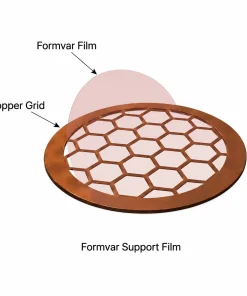
TEM Consumables & Accessories
TEM Consumables & Accessories
TEM Consumables & Accessories
TC1 TEM Copper, Gold & Nickel Grids with Carbon/Formvar Films, 200-300 Mesh
Reviews
There are no reviews yet.